The Private Blockchain Fallacy
Stop implementing a failed-by-design and dead-before-release thing. Just do a private git repository with signed commits, or a distributed ledger.
This post is translated from the original by Bèr Kessels, published on his personal blog. Discussions of the original:
To understand why private blockchains are nonsense, we first have to define what a blockchain is and what it isn’t. The father of Bitcoin (Nakamoto) set out a few terms in Bitcoin’s white paper:
a peer-to-peer distributed timestamp server to generate computational proof of the chronological order of transactions
This highlights some key characteristics of a blockchain:
- peer-to-peer: distributed and decentralized, with no
central authority - computational proof: verifiable
- timestamp-server/chronological ordering: implies permanence, no changes, immutability
Marco Iansiti and Karim R Lakhani give an easier explanation:
an open, distributed ledger that can record transactions between two parties efficiently and in a verifiable and permanent way.
- open (permissionless)
- decentralized
- verifiable
- permanent (immutable)
In other words: anything that doesn’t fit these criteria, by Nakamoto’s definition, is not a blockchain. It may be something similar, or even something that uses similar techniques, but it can’t be called a blockchain or a subset of a blockchain. This is important.
We can also look at it from another angle: if a blockchain provides these characteristics, when do we need one?
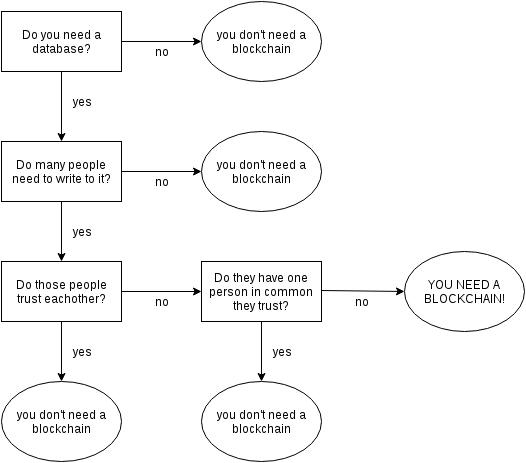
If your requirements don’t match exactly what a blockchain gives you, you don’t need a blockchain. In the case of a private blockchain: it isn’t public, so you can’t call it a blockchain. We could stop right here!
Reasons for a private blockchain
So why do people start with a private blockchain? We can group the arguments into three main ideas, and I’ll add a fourth:
- This way, we can store private data or other kinds of data that shouldn’t be public. (Drop
openandverifiableto get privacy) - This way, we can control who gets read/write access to the data. (Drop
opento get control) - This way, we can scale better. (Drop
distributedto get speed) - We aren’t confident enough about security and other factors to launch a public blockchain network. (Drop
permanentto get flexibility)
The fourth is the only reasonable argument for using a private blockchain, as a temporary stage while you’re still developing and exploring applications inside and outside of a blockchain: much like how you’d release an app to five friends first instead of uploading it straight to the app store.
All the other reasons are nonsense, because you don’t need a blockchain to get exactly those results. Or because, by definition, implementing it that way makes it not a blockchain. You could say that if you deploy a blockchain network in a private environment, it’s no longer a blockchain.
There are more reasons, keep reading.
It must be public
A blockchain needs to be public to guarantee permanence and immutability.
Take an easy example: say we have a family diary (to record each family member’s personal spending). If only I keep that diary, I’m the only one who can read and edit it.
So if I bought an expensive pair of shoes, and a week later I want to hide that fact, I simply delete that line from the diary, or replace the expensive shoes with anything else. And done, I never bought those shoes (according to the diary).
But if everyone in the family has the diary, to review or copy, it becomes a bit more immutable. I can still remove the bought expensive shoes line, but everyone in the house can tell, and they can call me out and ask. The more people can access the diary (say, sending a copy every week to all your family and friends), the harder it is to change the content afterwards.
However, a blockchain has one added feature: through cryptography, it makes it easy to detect when a line has been changed. So everyone who holds a copy can reliably and easily detect that something that shouldn’t change has been changed. But this feature only exists if the interested parties can get a copy. In a private blockchain, it’s really easy to change something, even when the change has a big impact. Because things are not fully public.
The public part is what guarantees permanence and immutability. Not because you can’t edit something (you absolutely can) but because those changes (thanks to cryptography) are detected by all other participants.
In theory, Bitcoin is not completely permanent or immutable. If enough participants decide that the 0.01 BTC you paid John a year ago was sent to Mallory instead, here’s what happens: history gets rewritten. Bitcoin’s immutability comes from the fact that anyone can detect such a change, and that the majority then has to acknowledge it.
In a blockchain, public or private, immutability is an agreement between all participants not to change history. It’s not something “magical that comes from cryptography”. In a private blockchain, that promise is very easy to keep. And even easier to enforce: if Mallory changes something in the ledger’s history, just kick him out of the network.
Immutability is an agreement, so you can just pick any kind of database, even a shared Excel sheet, and promise each other never to change anything. All you need is to detect whether something has been changed, which most database (or logging) systems provide. You can even add some cryptography on top to make tampering obvious and easier to detect.
It must be permissionless
A blockchain needs to be permissionless (peer-to-peer, all participants have equal rights) to guarantee permanence and immutability.
If you can control who has access, you control who gets to decide what the truth is. So you hold the power to change history any way you want.
Back to the family diary example: whoever controls the read/write access to that diary has the power to change the diary’s history.
That person would have full control over rewriting history. Because if anyone objects to that person’s changes (to the history), they can revoke that objector’s read/write access to the diary (which means removing the dissenter from the network).
Immutability in a blockchain is not something magical that comes from fancy technology. It comes from the conditions a blockchain network requires: the environment or “world” it operates in is what makes it immutable: a permissionless environment where everyone has equal rights.
As we know today, there really is a “magic” technology that guarantees immutability and permanence. That technology is called blockchain. And it has to be a public, permissionless blockchain.
It must be decentralized
A blockchain must be decentralized and distributed so that the truth can be verified.
The opposite of decentralized is centralized. In the family diary example, decentralized and distributed means that many times a day (even right after every change) copies of the diary are made and exchanged among everyone. More importantly, none of these copies is treated as “the truth”.
If there’s only one copy of the family diary, changing its content (like removing a page) is trivial and, if done well, undetectable.
The obvious solution is to copy every page (say, daily) and keep those copies in many places. This is distributed and decentralized. It’s slow and expensive, compared to having one copy and simply trusting it (as the truth). But that’s the essence of what a blockchain does. Because the real reason for trust: you don’t need to trust any single party holding the ledger. This is the trustless property of a blockchain.
When all copies at all times are considered the truth, any difference between copies will be detected and will trigger an alarm. Then we need conflict resolution: which one is the truth?
Bitcoin simply declares: what the majority of copy holders have is the truth. So if your diary is copied among five people and two of them have “berkes bought expensive shoes” in it but three don’t, the conclusion is that berkes did not buy expensive shoes.
To be clear: when you don’t need that trustless property, meaning when you can trust a central authority, you don’t need a blockchain. To stress it once more: if it requires trusting a single party, then by nature it is not a blockchain.
So what about coins based on private blockchains?
If it’s a private blockchain or a permissioned blockchain, then it’s not a blockchain. It can still be considered a database backed by cryptography, or a solid cryptocurrency on a very modern database, but it simply doesn’t use a blockchain. And because it doesn’t use a blockchain, it lacks one or more important characteristics.
That means a company can run off with your money at any time. Or it means it’s fundamentally insecure. Or it might offer some very interesting solutions…
I could build a very useful and interesting currency exchange system based on trust and a Google spreadsheet. But it wouldn’t be a blockchain. It would be “just” a spreadsheet on Google’s servers (with a really novel idea around it).
“You say it’s a blockchain, fine, it’s a blockchain”
Sure. If you want to call any database a blockchain, go ahead. If you insist on calling a Google spreadsheet a blockchain: fine. Blockchain isn’t a protected term or a trademark. You’re even allowed to call my bicycle a blockchain (it has a chain, after all).
But this helps nobody. Because either you’re reinventing the wheel, or you’re using an extremely inefficient technology when existing ones would be more efficient and more helpful.
Some private blockchains aren’t blockchains because they’re simply other technologies.
But unfortunately, most private blockchains today are really inefficient, not entirely secure, or simply dumb implementations: they bring none of the benefits of a public blockchain, but have all of its downsides (the blockchain tradeoffs).
Take git, for example: git is not a blockchain; git is a DAG (Directed acyclic graph); so don’t call it a blockchain. A DAG is very elegant, a good data structure. Git can even be used to store distributed data among a small group of participants, with hashing or cryptography to help them easily detect suspicious changes. I’m mentioning git because some cryptocurrencies do exactly this: use a DAG to share the truth among a private group of participants.
Or BitTorrent: BitTorrent is not a blockchain; so don’t call it one. BitTorrent is a very clever implementation of Merkle trees and does a great job distributing large amounts of data across a large number of participants. It isn’t a blockchain, and I’m mentioning it because this technology is usually enough if you need to make sure all participants have a copy of the data (the diary, the ledger).
There are thousands of databases out there, some that sync data quickly, some with extremely high write speed, and some with extremely powerful consistency checks. A cryptographically based log (with digital signatures) is not called a blockchain, it can be called a distributed ledger. We don’t call all of those things “blockchain”, and a private blockchain should never be considered a subset of blockchain.
Discussion
The article’s author: “The reason that I am “harsh” on it is because on one side all the innapropriate uses of “blockchain” hurt the larger cryptocurrency community, while on the other side it leads to loads of developers, agencies and enterprises implementing stuff that cannot be implemented.
So, on one side, we get “See! Blockchain is a hype, just let it die” from all the stupid and silly projects. And on the other side we see, over and over, people retrying those stupid and silly projects, because too few people have stepped up to explain that it is stupid.
There is very few actual use-cases for a blockchain. We are still figuring out what they are, and that goes with trial and error. But one thing has been very clear from very early on: a blockchain has to be public in order to work in the first place. So if five years afterwards IBM releases some toolkit that “allows a private blockchain”, I get annoyed.
No. You did not release that IBM. You released a failed-by-design and dead-before-release thing. Stop it already.”
Moodles: “Exercise for the private blockchain advocates: explain as simply as possible why a “private blockchain” is better than Git (with signed commits).”